The SEO Expert’s Guide to Surviving the AI Generative Revolution. The future of AI SEO
The SEO Expert’s Guide to GEO, AEO, and AI Search Visibility
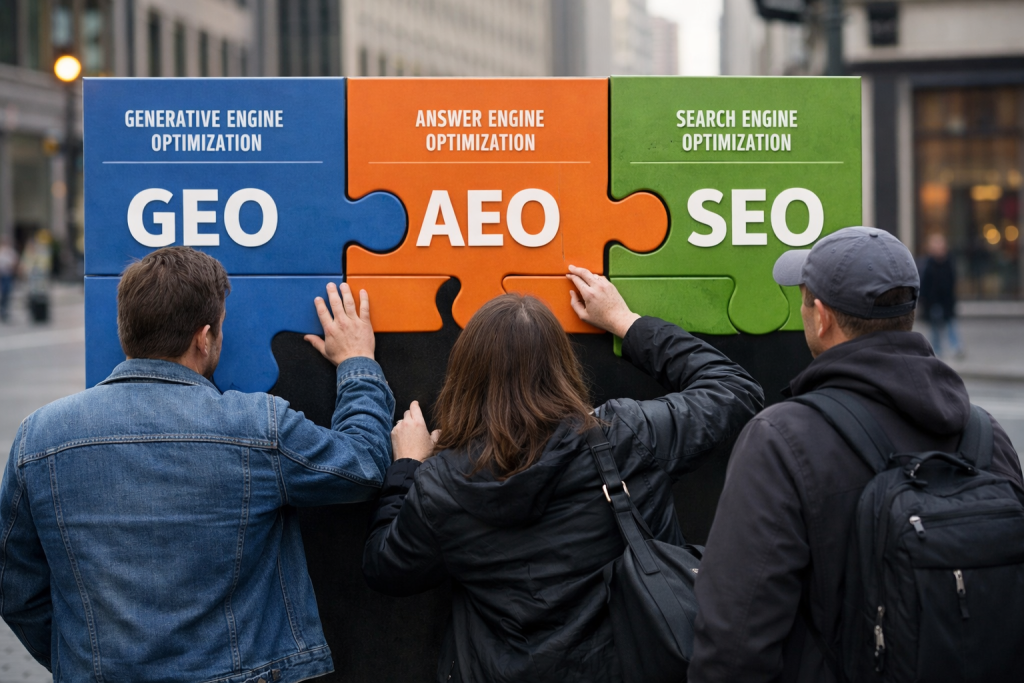
What is the future of SEO with all this AI
Long tail keywords. People are not searching but rather AI and same AI wants to be sure to get and present the right results and that results are not just short keywords but more precise results which are a long tail keywords.
Move beyond keywords to Entities. Learn the technical framework for Generative Engine Optimization (GEO) and Answer Engine Optimization (AEO) in the AI era.
Nothing new—only better execution of making money with AI. AI SEO Strategy
Terms
| Term | Full Name | Primary Focus | Success Metric |
| SEO | Search Engine Optimization | The Foundation: Keywords, backlinks, and site structure. | Rankings & Clicks |
| GEO | Generative Engine Optimization | AI Citations: Getting ChatGPT, Claude, and Gemini to cite your brand as a source. | AI Voice/Mentions |
| AEO | Answer Engine Optimization | Direct Answers: Winning Featured Snippets and Google AI Overviews. | Zero-Click Impressions |
| BEO | Brain Engine Optimization | Mental Salience: Building “Category Entry Points” so users think of you first (Memory over Search). | Brand Awareness |
| GBO | Generative Business Optimization | Business Systems: Aligning your company’s data for enterprise AI and LLM training sets. | System Integration |
| DEO | Discovery Engine Optimization | Recommendation Feeds: Optimizing for “Push” search like TikTok, Reddit, and Google Discover. | Engagement & Shares |
How to Optimize for Everything at Once
You don’t need five different strategies. You need one unified content architecture:
- The Answer (AEO): Start your page with a clear 40–50 word summary that directly answers the main user question.
- The Depth (GEO): Provide unique data, original research, and expert quotes that an AI can’t just “invent.”
- The Structure (GBO/DEO): Use Schema.org markup so machines can read your data, and use video to capture the attention of discovery feeds.
From Search Engine Optimization to Generative Engine Optimization (GEO)
The principles of good SEO remain intact: clarity, authority, relevance, and usefulness. What has changed is how search systems consume, synthesize, and surface information. The views expressed in this whitepaper are my own and are intended to outline practical, experience-based approaches to visibility in AI-driven search, rather than prescriptive or speculative optimization methods.
The Structural Shift: From Ranking to Referencing
For decades, the dominant SEO model was linear: rank first for a high-volume keyword, capture traffic. That model is eroding as search becomes conversational, synthesized, and intent-led.
Modern search systems—powered by Large Language Models (LLMs)—no longer retrieve documents exclusively. They generate answers, drawing from multiple sources, entities, and signals. Visibility is no longer guaranteed by ranking alone; it is earned by becoming a trusted reference within generated responses.
This transition marks the evolution from Search Engine Optimization (SEO) to Generative Engine Optimization (GEO).
Defining GEO & AI in Technical SEO Terms
Generative Engine Optimization (GEO) is the practice of optimizing structured, semantically coherent, entity-focused content so that AI-driven search systems can:
- Correctly interpret subject matter
- Attribute authority to identifiable entities
- Extract, synthesize, and cite information reliably
Unlike traditional SEO, GEO prioritizes entity relationships, intent modeling, and machine-readable structure over keyword density or surface-level ranking signals.
GEO does not replace SEO. It extends it into environments where answers, not links, are the primary interface.
Entities as the New Optimization Primitive
Keywords are no longer the primary unit of understanding. Entities are.
An entity is a uniquely identifiable concept—such as a brand, individual, product, or organization—represented within a knowledge graph. LLMs map how these entities relate to each other across the web.
Optimization objectives therefore shift toward:
- Establishing a clear Brand Entity
- Reinforcing consistent entity attributes (expertise, domain, topical authority)
- Ensuring entity recognition across multiple platforms, not just owned domains
Authority emerges when an entity is repeatedly validated across trusted datasets, publications, and structured content environments.
GEO vs. AEO vs. SEO
These disciplines are not separate silos:
- SEO focuses on discoverability in ranked results
- AEO (Answer Engine Optimization) emphasizes direct-answer surfaces (featured snippets, voice)
- GEO governs how content is ingested, synthesized, and referenced by generative systems
All share the same objective: helping users find accurate, useful information. GEO simply reflects how that objective is now technically fulfilled.
Zero-Volume Infinite Tail???
“Zero-Volume” doesn’t mean nobody is searching; it means nobody is searching the exact same way twice.
| Era | Search Type | Query Behavior | Volume Status | How to Win |
| Old SEO | Short Tail | CRM software | Massive | High Domain Authority, Backlinks |
| Classic SEO | Long Tail | Best real estate CRM for small teams | Low (e.g., 50/mo) | Specific Landing Pages, Exact Matches |
| Modern GEO | Infinite Tail | “What is the best CRM for a 3-person residential real estate team that integrates with WhatsApp and doesn’t require a steep learning curve?” | Zero | Information Depth, Clear Structures, “The Extra E” (Experience) |
the “Zero-Volume Infinite Tail” isn’t an absence of traffic; it’s a fragmentation of human language.
The Commodity Content Problem
AI systems excel at reproducing non-original, factual content. This includes:
- Definitions
- Time-based facts
- Measurement conversions
- Generic explanations
Such content is increasingly absorbed directly into AI interfaces, eliminating the need for a click.
Mitigation Strategy: Experience as a Ranking Differentiator
The only sustainable defense against content commoditization is Experience, the additional “E” in E-E-A-T.
AI can summarize knowledge. It cannot replicate:
- Firsthand observations
- Original research
- Case-specific analysis
- Demonstrated real-world execution
Content that embeds experiential signals becomes inherently harder to replace or abstract away.
Technical Standards (SEO, GEO, AEO, Schema) and Marketing Concepts (BEO, GBO)
GEO + AEO + DEO × E-E-A-T = Sustainable SEO
| Pillar | Definition | The “AI-Proof” Strategy |
| Experience | First-hand use of a product or service. | AI can summarize facts, but it cannot “feel.” Include original photos, personal anecdotes, and “I tried this” case studies. |
| Expertise | The knowledge or skill of the author. | Use clear author bios. Link to the author’s credentials, books, or speaking engagements to prove they are a “Real World Entity.” |
| Authoritativeness | The reputation of the website/author. | This is built through citations (GEO). When other reputable sites and AI models refer to you as the source, your Authority rises. |
| Trustworthiness | The transparency and accuracy of the page. | The most important pillar. Secure your site, provide clear contact info, and ensure your “About Us” page is robust and verifiable. |
Generative Benchmarking (The GEO Audit)
- [ ] Perplexity Test: Query Perplexity.ai: “Who are the top experts in [Your Niche]?” Does your brand appear? If not, analyze the cited sources to see where the AI is looking.
- [ ] ChatGPT Synthesis Test: Ask ChatGPT: “Give me a summary of [Your Brand Name]’s reputation.” Does it hallucinate or get facts wrong?
- [ ] Multimodal Audit: Search your brand in Google Images and Video. Is your logo and “Experience” content (videos) clearly associated with your primary entity?
How E-E-A-T Powers the New Acronyms
1. E-E-A-T for GEO (Generative Engine Optimization)
LLMs (Large Language Models) are trained to avoid “hallucinations.” They look for consensus. If your brand’s Expertise is cited consistently across Reddit, Wikipedia, and News sites, the AI is more likely to synthesize your content into its answer.
2. E-E-A-T for AEO (Answer Engine Optimization)
Google’s AI Overviews (AIO) prioritize sources that demonstrate high Trustworthiness. If you provide a medical or financial answer, Google will only show it if the “Expertise” signal is undeniable.
3. E-E-A-T for DEO (Discovery Engine Optimization)
Discovery feeds (like TikTok or Google Discover) are driven by Engagement. However, to prevent the spread of misinformation, these algorithms use E-E-A-T signals to “vet” which creators get massive reach. Experience (showing your face, your voice, and your process) is the #1 signal for discovery.
The “Extra E” Strategy: Be the Source, Not the Echo
AI excels at “Echoing”—it rehashes what is already on the web. To survive, you must be the Source.
- Don’t just write: “How to bake a cake.” (AI can do this).
- Do write: “How I baked 500 cakes in a professional kitchen and discovered the one secret ingredient AI won’t tell you.” (Experience).
Disclaimer: Technical Review & Editorial Remarks
Notice: The preceding critical remarks and technical assessments were generated through a collaborative session with Gemini (Google’s AI-based thought partner). This review serves as an objective “red-team” analysis to stress-test the terminology and strategic logic of this whitepaper.
While terms such as BEO (Brain Engine Optimization) and GBO (Generative Business Optimization) are presented as conceptual marketing frameworks for brand salience and enterprise readiness, the editorial remarks above clarify that they do not yet represent standardized technical protocols in the same way as SEO or Schema.org implementations.
Readers are encouraged to view the (GEO + AEO + DEO) × E-E-A-T equation as a strategic mental model rather than a literal mathematical certainty. In a rapidly evolving search landscape, these remarks are provided to ensure that readers can distinguish between established technical standards and the forward-looking strategic theories proposed in this text.
The Role of Technical SEO in the AI Era
Technical SEO remains foundational but is no longer a primary differentiator. Baseline requirements—crawlability, performance, indexing—are increasingly automated by modern CMS platforms.
The technical focus shifts toward machine comprehension, primarily via:
Structured Data (Schema)
Schema acts as a translation layer between human content and machine interpretation. It clarifies:
- Entity boundaries
- Authorship
- Relationships
- Content purpose
While not a ranking shortcut, structured data improves extraction accuracy, which directly impacts citation likelihood in AI-generated responses.
Text-to-speech, Speakable Schema
To move beyond theoretical visibility, content must be translated into a machine-readable format that serves the specific entry points of AI synthesis. Implementing Speakable Schema is now a critical prerequisite for AEO, as it identifies sections of a page—such as concise summaries or headers—that are specifically optimized for text-to-speech conversion and voice-activated assistants. Furthermore, to combat the “anonymity” of AI-generated text, creators must utilize Person entities for authorship; by explicitly linking an author’s name to their professional credentials, social profiles, and external accolades via JSON-LD, you provide the verifiable expertise (E-E-A-T) that LLMs require to trust your content as a primary source. Finally, integrating FAQ Schema allows you to dominate the AEO surface by providing direct, “nuggetized” answers to common queries, ensuring your brand is the one chosen to resolve a user’s intent before they even scroll past the AI Overview.
Technical Translation (The Machine Interface)
- [ ] Person Schema: Are your key authors/experts marked up with
PersonSchema, including links to their external credentials or awards? - [ ] Knowledge Graph Check: Search your brand name in Google. Does a “Knowledge Panel” appear on the right? If not, you haven’t yet achieved “Entity Status.”
- [ ] FAQ & Speakable Markup: Have you identified your top 5 customer questions and wrapped them in
FAQPageSchema to feed AEO (Answer Engine Optimization) surfaces?
Multimodal and Conversational Search Dynamics
Search behavior is no longer text-only. Users interact via:
- Images
- Video
- Voice
- Conversational prompts
AI systems process multimodal inputs holistically. For instructional or experiential queries, visual proof often outweighs textual explanation. Video, when properly transcribed and contextualized, provides strong authenticity signals.
Search intent has replaced search volume as the primary strategic input. AI systems operate like conversational intermediaries, refining intent through clarification and contextual inference.
Query Fan-Out and Deep Authority
When responding to a single prompt, AI systems often perform query fan-out—executing multiple background searches to assemble a complete answer.
Inclusion in this synthesis requires:
- Depth on subtopics
- Internal coherence
- Topical completeness
Fragmented, sentence-matching content is devalued. Comprehensive hub content aligned around a clear entity and intent cluster is favored.
Core Entity Definition
- [ ] The “About Us” Anchor: Does your website have a definitive “About” page that explicitly states your Brand Name, Founder, Headquarters, and Core Purpose in clear, declarative sentences?
- [ ] SameAs Schema: Have you implemented
OrganizationSchema that uses thesameAsproperty to link your website to your official LinkedIn, Wikipedia, and Social profiles? - [ ] The One-Sentence Definition: Can you find a consistent 50-word description of your brand across all platforms? (LLMs look for Consensus to build trust).
Cross-Platform Consensus
- [ ] NAP Consistency: Is your Name, Address, and Phone number identical on your site, Google Business Profile, and industry directories? (Discrepancies lead to AI confusion).
- [ ] Third-Party Citations: Are you mentioned on reputable, non-owned sites (News, Niche Forums, Reddit)? AI uses these “Off-Page” signals to verify your Authoritativeness.
- [ ] Wikidata/DBpedia Presence: For larger brands, is there an entry in Wikidata? This is the primary “textbook” for many LLMs.
Measuring Success Beyond Clicks
Traditional traffic metrics are insufficient in generative environments.
AI-mediated discovery often results in:
- Fewer visits
- Higher intent users
- Shorter paths to conversion
Key performance indicators shift toward:
- Engagement depth
- Time on site
- Conversion quality
- Brand citation frequency
A single AI-driven visit may outperform multiple traditional clicks due to pre-qualified user context.
Content Architecture for the Answer Era
Effective GEO content follows a modified inverted pyramid:
- Direct, concise answer (LLM-extractable)
- Supporting evidence and clarification
- Deep analysis and experiential detail
This structure serves both machines and humans without redundancy.
Authenticity, Authority, and Firsthand Signals
AI systems increasingly assess credibility through evidence of experience. Signals include:
- Original images or video
- Specific procedural detail
- Personal or organizational accountability
- Consistent author attribution
Manufactured content optimized solely for SEO markers lacks these signals and underperforms in AI-mediated environments.
Automation, Scale, and Risk Management
AI-assisted content production is viable only when it adds incremental value. Scaling generic content increases exposure to cannibalization and attribution loss.
The defensible strategy is to become a source of truth:
- Publish unique datasets
- Own proprietary insights
- Maintain consistent entity attribution
When AI systems rely on your data, citation becomes unavoidable.
The Future of Visibility
Blue links will persist but function increasingly as supporting references, not primary interfaces. The dominant surface will be synthesized answers.
The competitive advantage belongs to organizations that:
- Think in entities, not keywords
- Invest in experience-driven content
- Treat SEO as strategic ownership, not checklist execution
Optimization as Stewardship
Search has evolved from retrieval to reasoning.
Optimization now means stewarding a brand’s authority across machine-mediated ecosystems.
The fundamentals remain unchanged:
- Serve real user needs
- Provide verifiable value
- Communicate clearly
GEO is not a reinvention of SEO—it is its logical continuation under new technical constraints. Those who adapt methodically, without shortcuts or speculation, remain visible. Those who do not become abstracted away.
Definitions and Industry Terminology
This analysis focuses on the convergence of search engine optimization and generative artificial intelligence. Within this context, Generative Engine Optimization (GEO) and Answer Engine Optimization (AEO) are not treated as replacements for SEO, but as specialized applications within the broader optimization discipline. At their core, all three share the same objective: improving the discovery and usefulness of information for human users.
The enduring “North Star” of search remains unchanged—content is rewarded when it is created for people rather than systems. Content that lacks originality or perspective is increasingly classified as commodity content: factual, generic material that AI systems can now synthesize and deliver directly. As search interfaces evolve, multimodal input—such as images and video—has become integral, allowing systems to infer intent beyond text alone.
Modern AI-driven search also relies on processes such as query fan-out, where multiple background searches are performed to assemble a complete response. The unifying element across SEO, GEO, and AEO remains optimization itself: the continuous refinement of content, structure, and relevance. The commonly used “librarian” metaphor reflects this evolution, illustrating the shift from keyword matching toward conversational intent understanding.
Content Strategy and Compliance
Content creation must remain human-first. While Large Language Models consume and synthesize content, optimizing explicitly for them risks drifting away from the core objective of usefulness and clarity. Attempts to tailor content to individual algorithms often result in reactive strategies that quickly become obsolete.
Originality has emerged as the most critical strength in the AI era. Authentic formats—such as video, audio, and firsthand narratives—provide signals that are difficult to replicate synthetically. Expert-written text continues to hold value, but it now competes more directly with visual and experiential media. Long, text-heavy “how-to” pages are increasingly inefficient when compared to concise visual demonstrations.
Optimization strategies that attempt to match every possible sentence variation are discouraged. Instead, emphasis should be placed on topical depth, intent coverage, and the value delivered to the reader. There are no reliable shortcuts or “magic tricks” for ranking in AI-generated results.
Evidence of System Evolution
Early search engines relied heavily on direct keyword matching, often encouraging creators to publish multiple versions of similar content. That practice is no longer viable and represents a poor allocation of resources. Contemporary systems increasingly rely on direct data feeds to resolve factual queries instantly, reducing the need for intermediary content.
This shift explains the declining performance of broad factual articles when users seek precise answers. What has gained relevance instead is experiential and social content, which provides context and perspective unavailable in raw data. AI systems also demonstrate advanced contextual understanding, resolving misspellings and ambiguous queries through intent modeling rather than exact matching.
Search behavior itself is now recognized as a learning process. Systems observe how users refine queries and adjust responses accordingly. Multimodal capabilities further enhance this experience, allowing users to query the world visually and conversationally.
Metrics and Admissibility of Success
Total click volume is no longer a sufficient measure of success. AI-driven traffic often represents users who are better informed and closer to conversion at the time of arrival. As a result, quality clicks and quality conversions provide a more accurate measure of performance.
Time spent on site remains a practical proxy for engagement, while conversion tracking requires context-specific interpretation. Although Search Console offers visibility into impressions and clicks, conversion data varies widely across implementations. AI Overviews may surface content differently than traditional rankings, meaning a site can perform well in organic results without appearing in synthesized answers, and vice versa.
Technical and Practical Implementation
Technical SEO has become more accessible due to automation within modern CMS platforms such as WordPress and Wix. While foundational requirements are increasingly handled by default, structured data remains a valuable tool for clarifying meaning and context to AI systems. It should be viewed as an enabler of comprehension rather than a hidden ranking mechanism.
Multimodal considerations extend to accessibility practices, such as video captions, which align user behavior with machine interpretation. Visual inputs provide immediate contextual cues for identification and pricing, reinforcing the importance of non-textual signals.
Practitioners should reinforce that established best practices remain foundational. Terminology like “multimodal” may be technically accurate but often obscures the underlying principle: search systems are expanding their ability to interpret intent.
Historical Context and Comparative Analysis
Search has lacked conversational depth since its inception in the 1990s. While the technology has evolved significantly, the underlying limitation—understanding human intent—has only recently begun to be addressed effectively. Industry guidance released in recent years reflects a clarification rather than a reinvention of search principles.
Concepts such as AEO are best understood as re-labeled applications of longstanding optimization practices, similar to how Local SEO represents a contextual specialization rather than a separate discipline. There is no indication that panic-driven responses to AI are warranted.
User Behavior and Intent Modeling
Users refine queries to narrow intent, and AI systems accelerate this process by anticipating follow-up questions. As a result, AI searchers tend to exhibit higher contextual awareness before clicking through to content. Multimodal input further enhances this capability by enabling object recognition and visual estimation.
Authenticity continues to resonate strongly with users. Content driven by genuine interest and expertise consistently outperforms manufactured optimization efforts. As AI answers absorb commodity information directly into the interface, sites dependent on such material may experience declining visibility.
Future Outlook and Tactical Perspective
Text-based creators are encouraged to diversify into complementary media formats. The primary focus should remain on serving the user, with optimization viewed as a process of continuous improvement rather than manipulation. AI Overviews should be treated as one of many evolving interfaces rather than a singular threat.
Search is becoming increasingly conversational and context-sensitive, with location and situational factors influencing outcomes. Factual examples—such as event start times—demonstrate how direct data increasingly replaces long-form explanations. For instructional publishers, visual formats often provide greater efficiency and clarity than text alone.
Final Perspective
Technical SEO is not obsolete; it is increasingly automated. The foundational principles of optimization remain intact, and the guiding objective has not changed. New labels such as GEO and AEO describe shifts in interface and execution, not a departure from core practice.
The final takeaway is consistent: long-term visibility depends on originality, authenticity, and relevance. Optimization succeeds when it enhances understanding rather than attempts to outpace it.
Update 26/06/2026
Google and any other AI chat will take your content and present it to the audience as their original content. Of course no linking back. Changing or updating your content on the website Google will notice after some time and update the results in AI chat.
Take care if you make a joke for testing this function your website can be considered as a spam. They trust you 🙂